Unlock Market Insights with Proprietary theories on price

Leverage unique models to predict and analyze price trends

Proprietary theories on price

The analytical models for predicting the price are based on years of research in decoding the science of the property's price. The two theories, the urban price setting model, predicts the current price of the property, and the magnet theory ascertains the future trajectory of the property prices.
Two core models govern this framework:
  • Urban Price Setting Model – Predicts the current price of a property.
  • Magnet Theory - Projects the future price trajectory.

Urban Price Setting Mode

The Urban Price Setting Model is a proprietary framework developed by Liases Foras after over two decades of research on real estate price dynamics. It simulates how prices are set across an urban landscape and predicts the prevailing property prices.

Core Principle:

A property’s price is governed by four key factors:
  • "Distance" (proximity to core areas or CBDs)
  • "Density" (economic or demographic concentration)
  • "Surrounding" (geographical and environmental attributes)
  • "Product" (quality and specifications of the property)
A multivariate regression model integrates these variables to predict property prices with high precision, capturing geospatial variations and product differentiation.

Rationale:

  • Every product (real estate asset) has a distinct value within a specific space.
  • The same product’s price varies based on its spatial dynamics location, density, and neighborhood quality.
  • Each city maintains aunique price equilibrium at any given point in time.
  • When prices change in one micro-market, it resets the equilibrium, influencing other surrounding areas and forming a new citywide price structure.

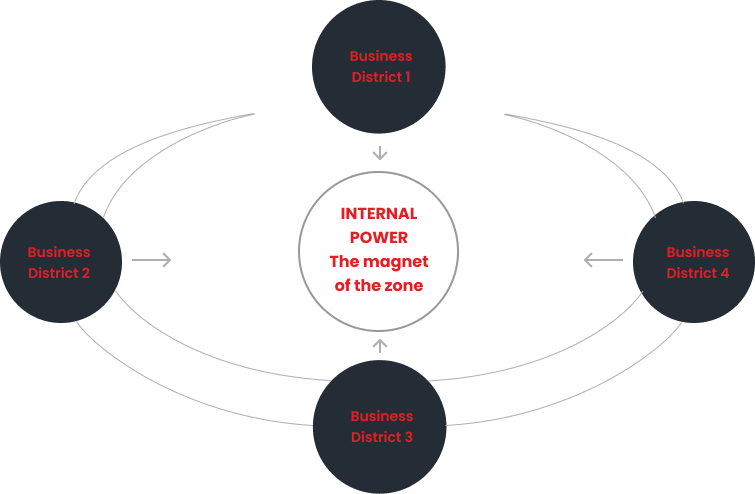
Magnet theory: Predictive Model Future Price Projection

The Magnet Theory explains how spatial mobility or polarization of demand occurs toward specific regions, depending on their internal magnets (economic attractiveness).
This metric serves as a relative index of attractiveness , where a higher index signifies higher demand potential and price growth.

Key Insights:

  • Real estate prices correlate strongly with the economic density of an area’s demographics.
  • Improvements in connectivity, infrastructure, or economic hub intensities shift these densities.
  • Tracking these shifts over time helps forecast future price projections and growth patterns.